Cases · Energy & mining · Buenos Aires
Everything published, on one page
Each piece started from a question the public data left open. They are all live, each with its source and its stated scope. The detail and the caveats live on the sector page.
Exploration and production 5 pieces
What the basin is doing before the official record says so. Each with scope and caveats: E&P.
-
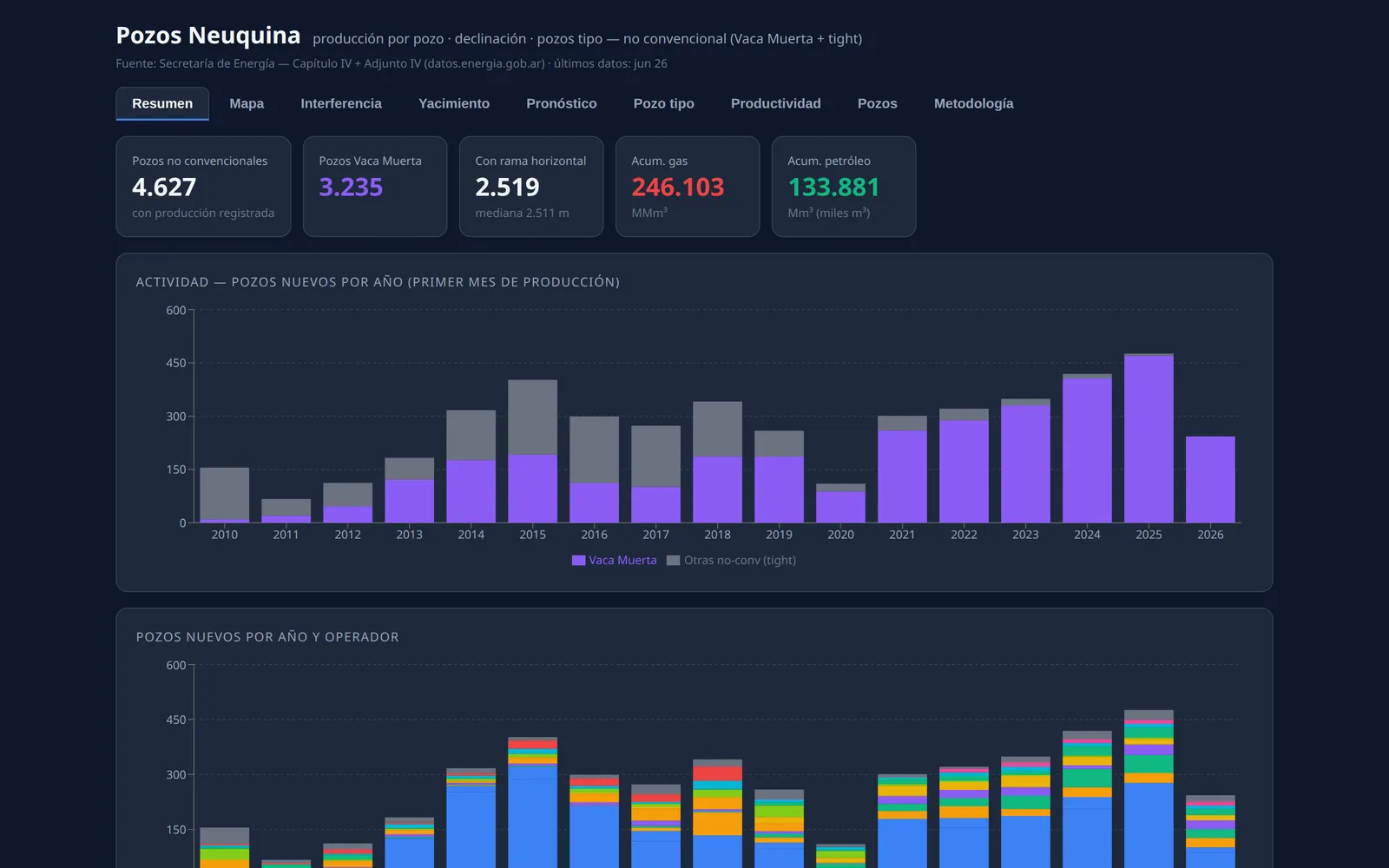 Decline curves, EUR and type wells
Arps fits and type wells by block, to set your own well beside the one the offset operator drilled at the same lateral length and the same spacing.
Chapter IV, SecEnergía · Neuquén basin · current -
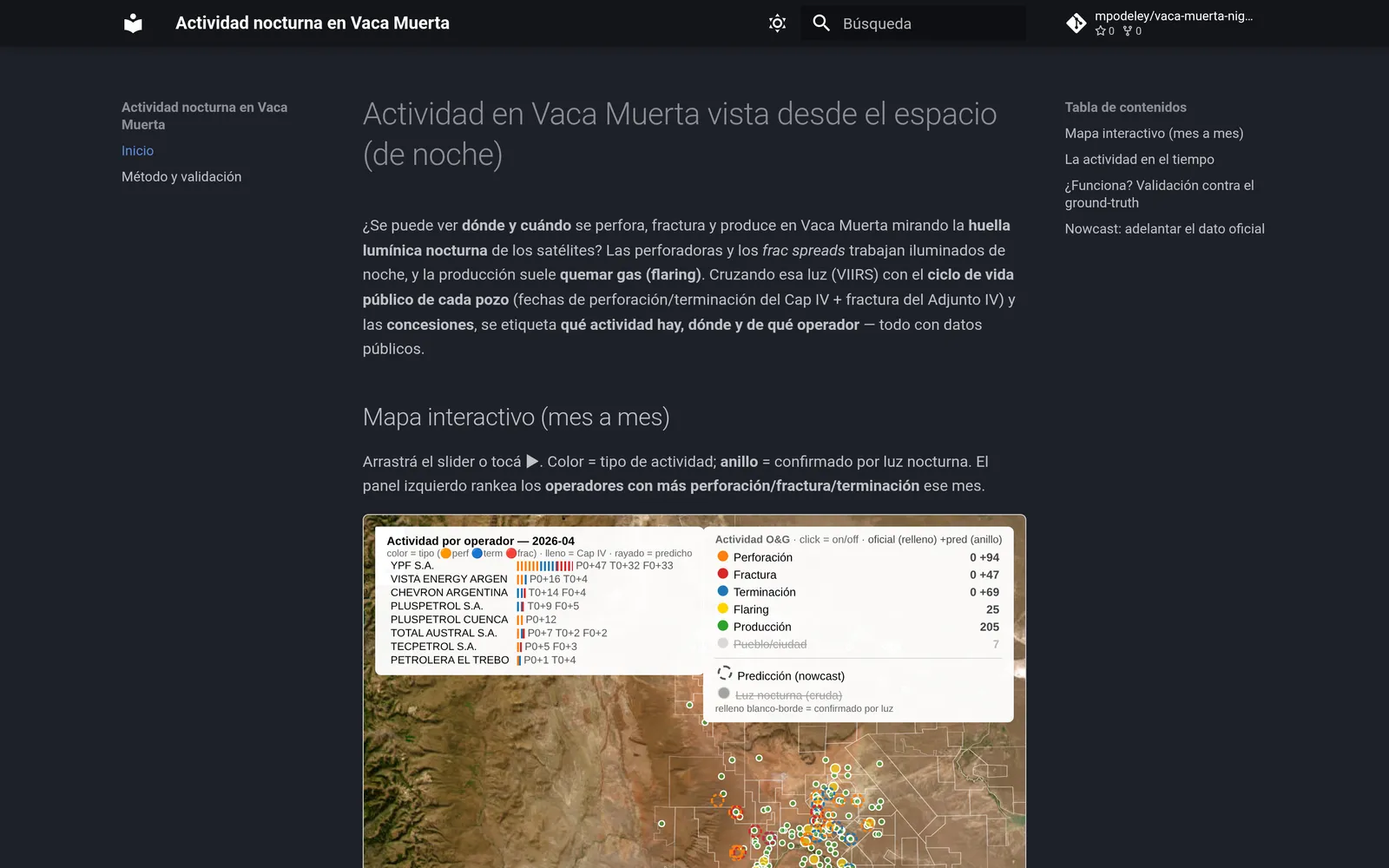 Activity from night lights
Covers the 13.5 months Chapter IV runs late: confirms 71% of 20,178 well events and estimates the rest, at ROC-AUC 0.85 for drilling and 0.91 for fracturing.
VIIRS + Chapter IV · Vaca Muerta · 2019–2026 -
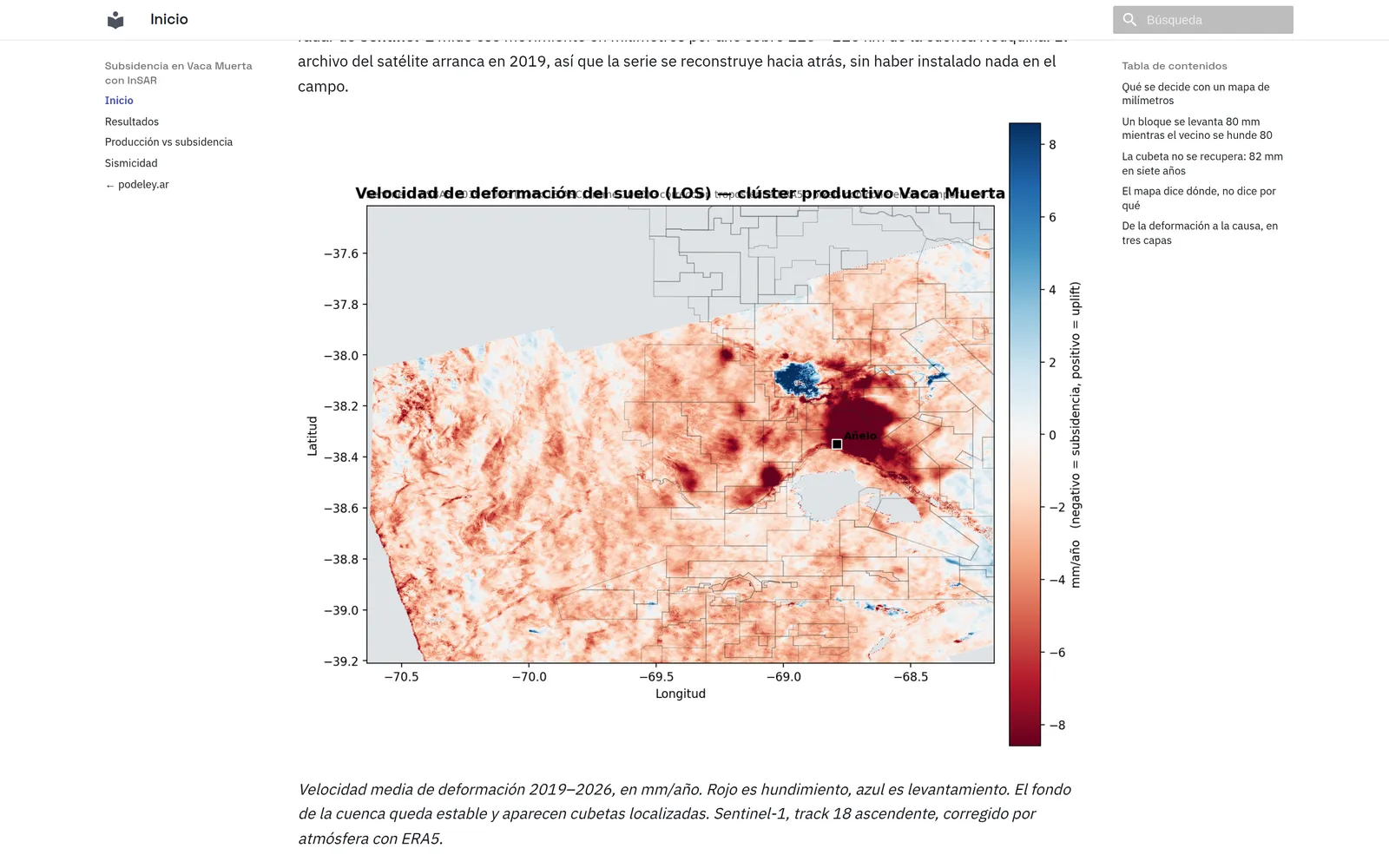 Ground deformation from InSAR
Seven years of series over the basin. The injecting concession and the producing one next door move in opposite directions, 80 mm each, and the edge between them is what shears a casing.
Sentinel-1 track 18 · 210 × 210 km · 2019–2026 -
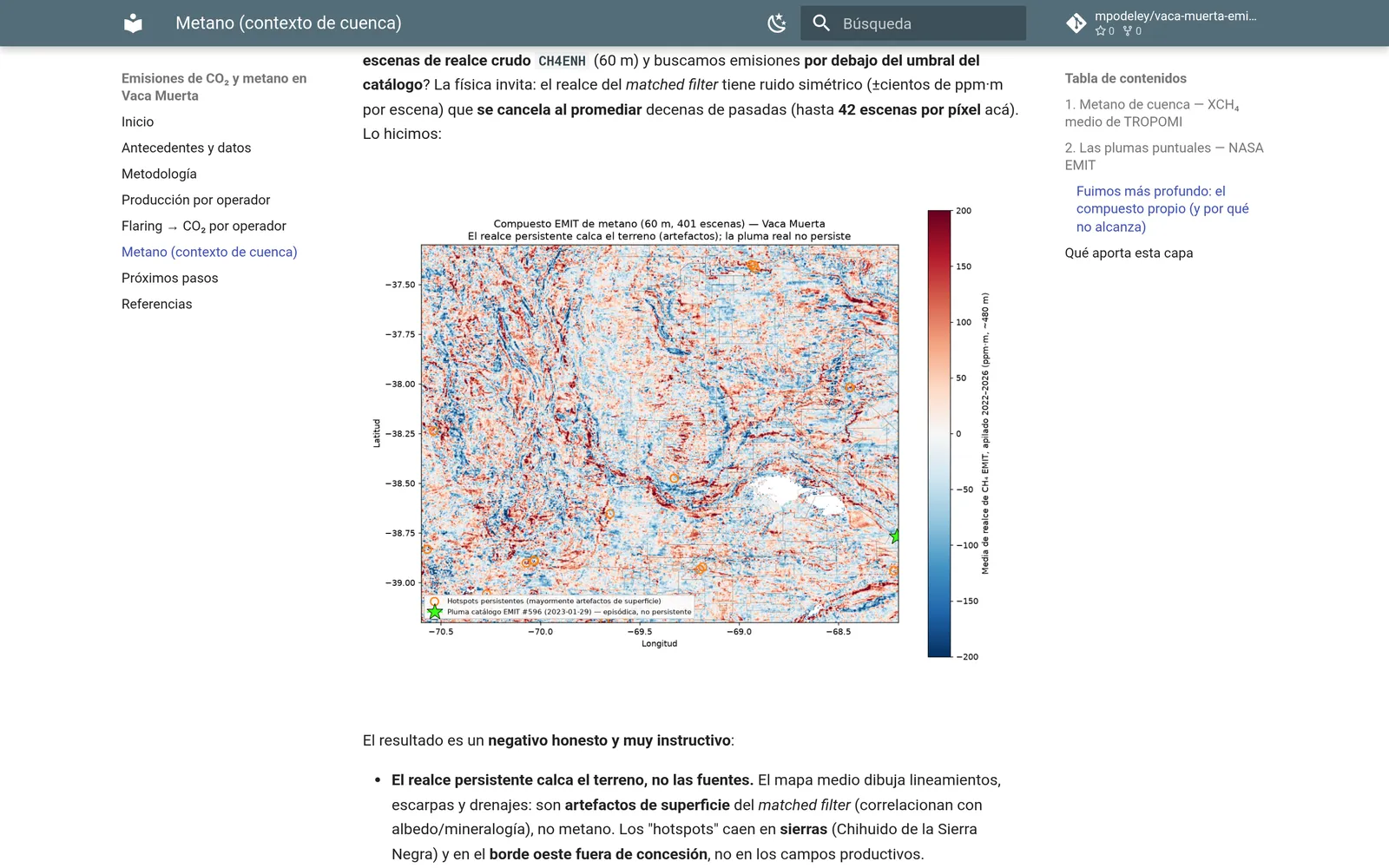 Emissions by operator
113 flares and 2.4 Mt of CO₂ in 2024, attributed by concession: between 2.1 and 31.9 kg of CO₂ per barrel of oil equivalent depending on who operates.
VIIRS Nightfire + Chapter IV · Neuquén basin · 2024 -
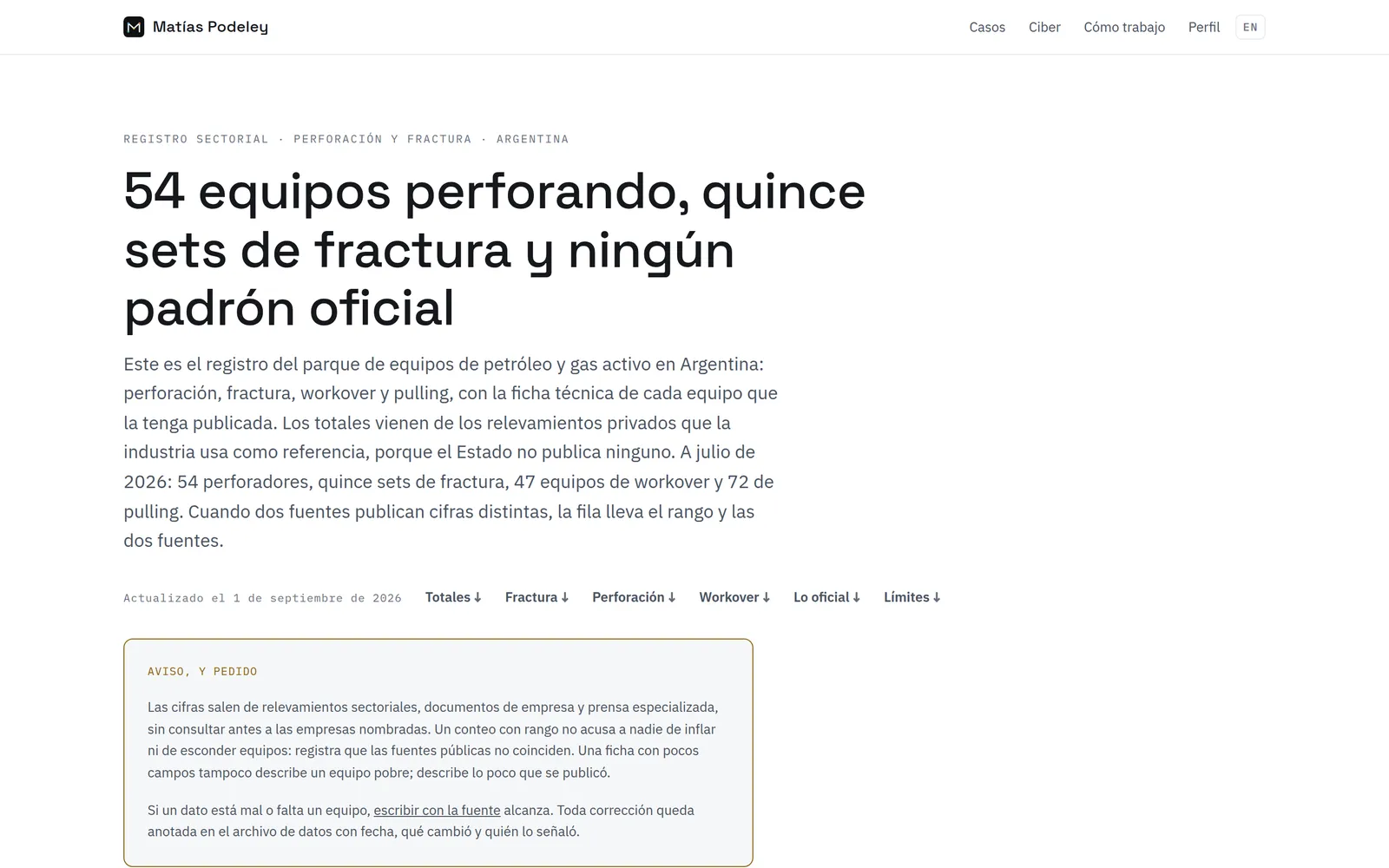 Equipment fleet register
54 drilling rigs, fifteen frac spreads, 47 workover and 72 pulling units as of July 2026. Per-company counts shown as ranges where sources disagree, and technical files with a source per specification.
Private surveys + Adjunto IV · downloadable dataset · CC BY 4.0
Mining 4 pieces
What sits over the ground, and what gets measured without walking it. All four, with scope and caveats: mining.
-
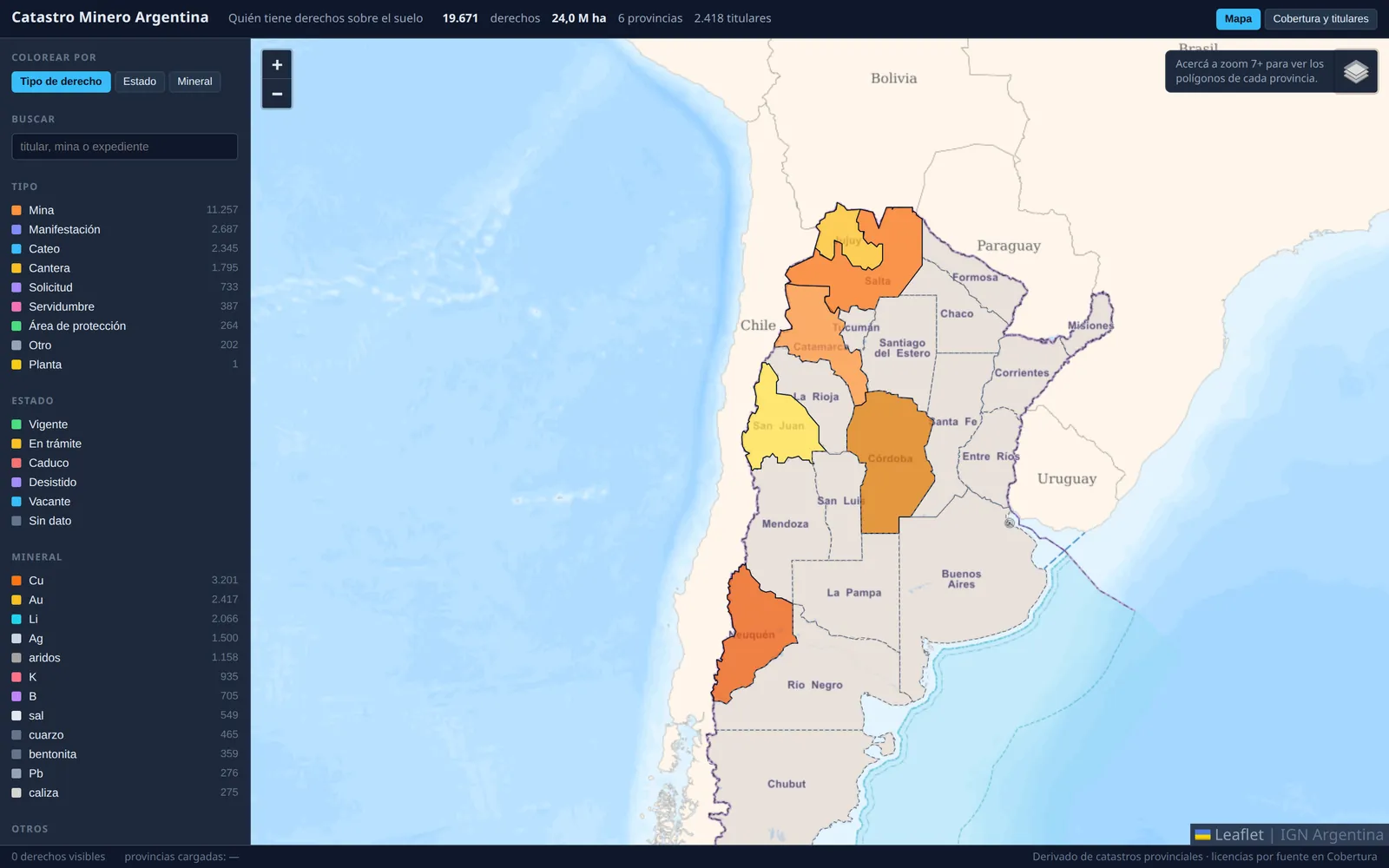 Unified mining claim registry
21,386 claims, 25.8 million hectares and 2,991 holders across seven provinces on one map, with the mineral and the case file behind every polygon.
Provincial registries · data to 2026-08 · open dataset -
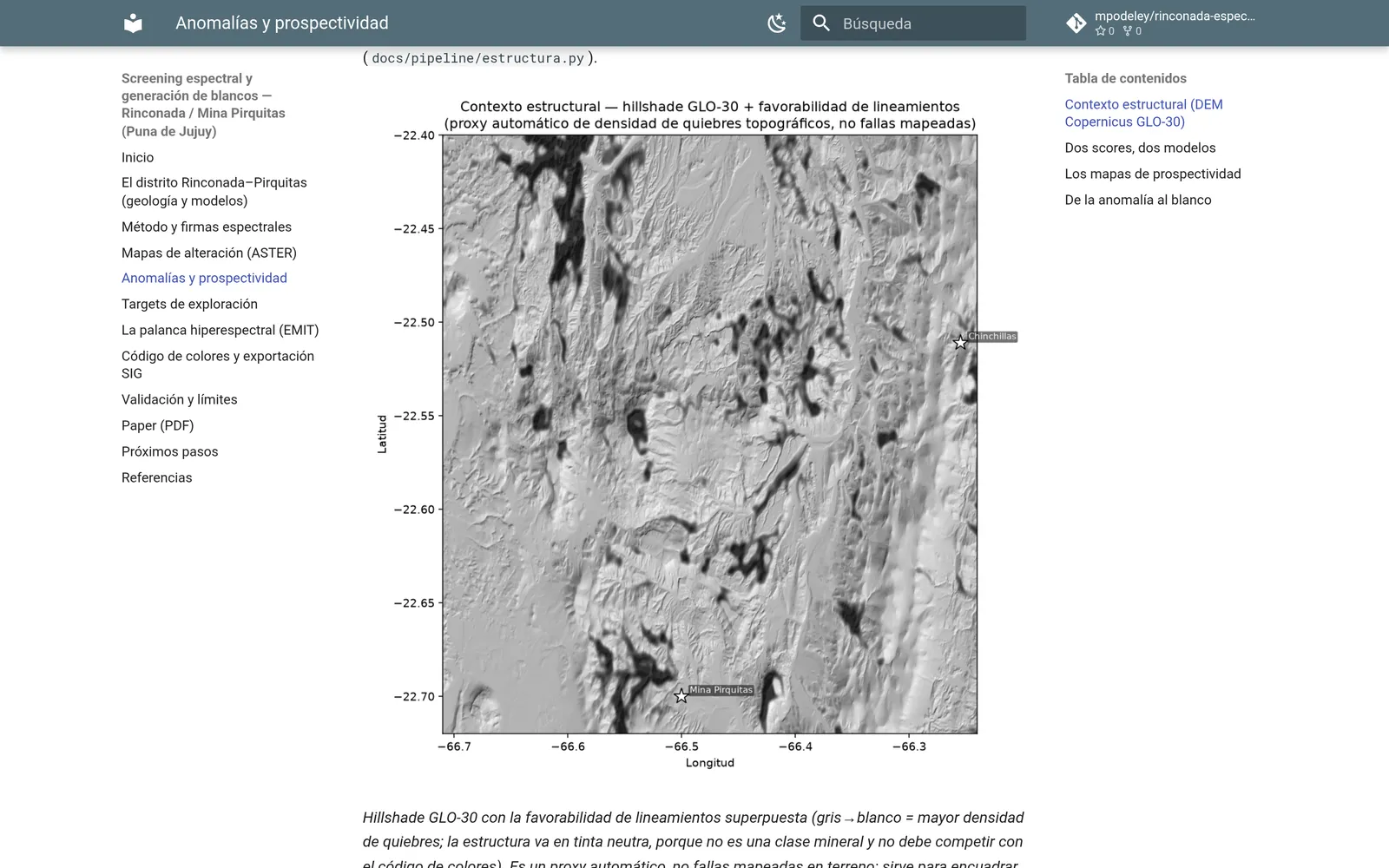 Exploration targets from spectrometry
1,877 km² of usable ground narrowed to 15 targets with coordinates. Tested blind: it re-finds Pirquitas and Chinchillas within 20 and 80 meters of the mapped footprint.
ASTER + EMIT · Puna de Jujuy · shapefile and GeoJSON -
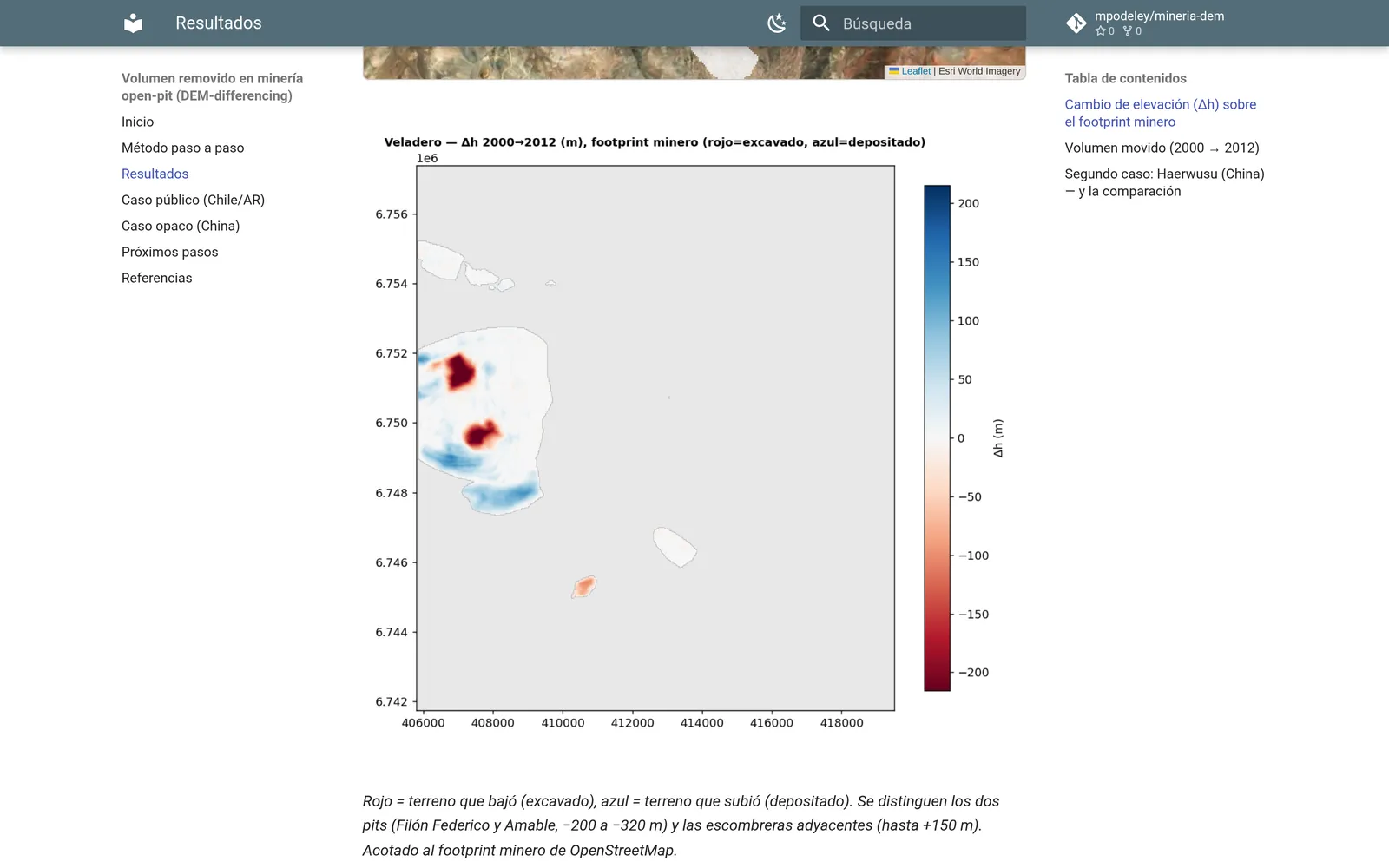 Excavated volume from elevation model differencing
Veladero comes out at 424 Mm³ excavated and 497 deposited between 2000 and 2024. At Haerwusu, where no production is published, the 1,742 Mm³ is the only independent measurement.
SRTM 2000 + ASTER stereo · 2000–2024 -
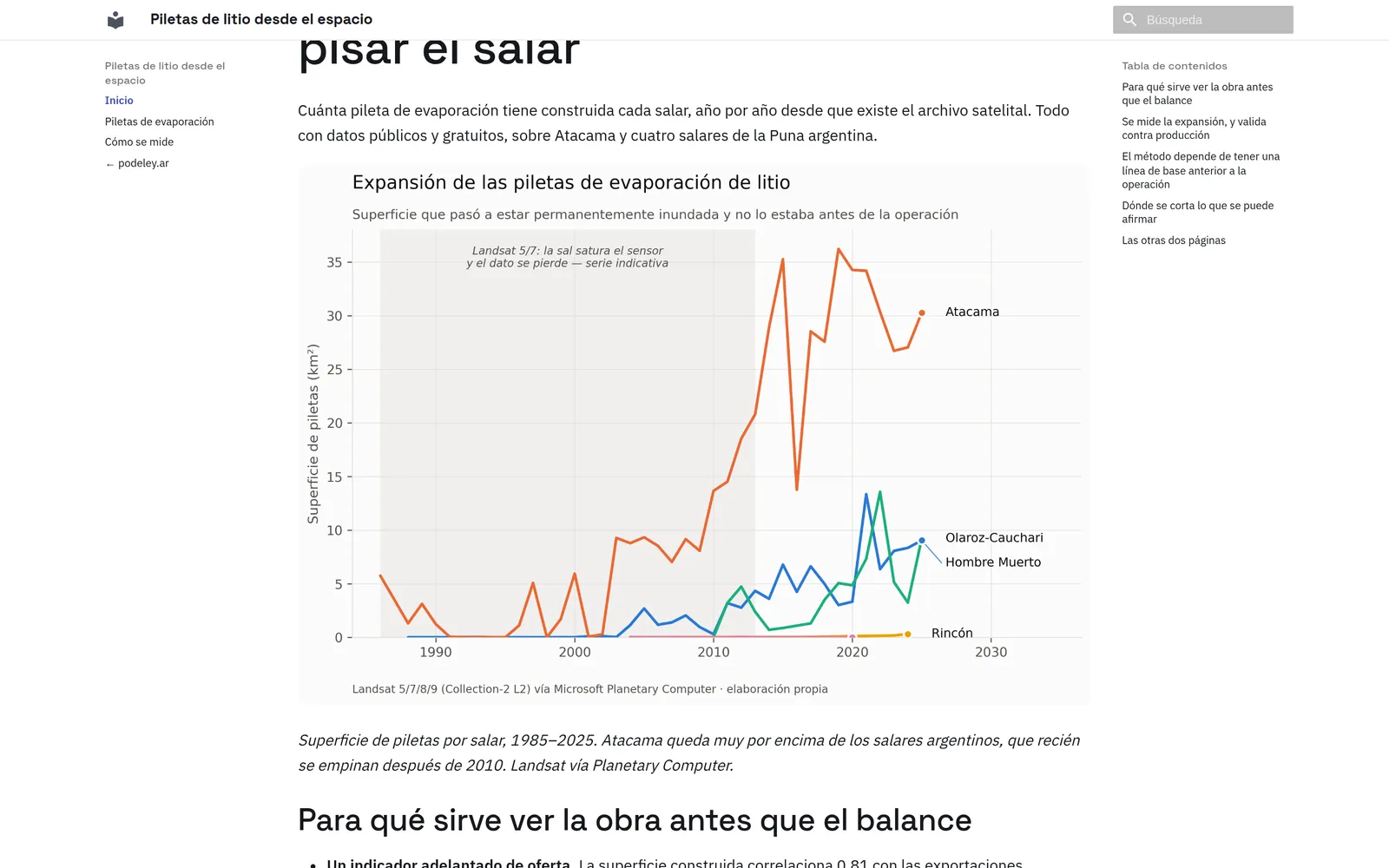 Lithium brine pond buildout, year by year
Five salars measured back to 1985. Built pond surface leads declared exports by two years at a correlation of 0.81, so an expansion announced without construction shows up.
Landsat · Atacama and 4 Puna salars · 1985–2025
Which material each sensor can separate, band by band: the 3D globe of the fleet.
Gas and power 2 pieces
How the gas arrives and what price a bid enters at. Both, with their assumptions: gas & power.
-
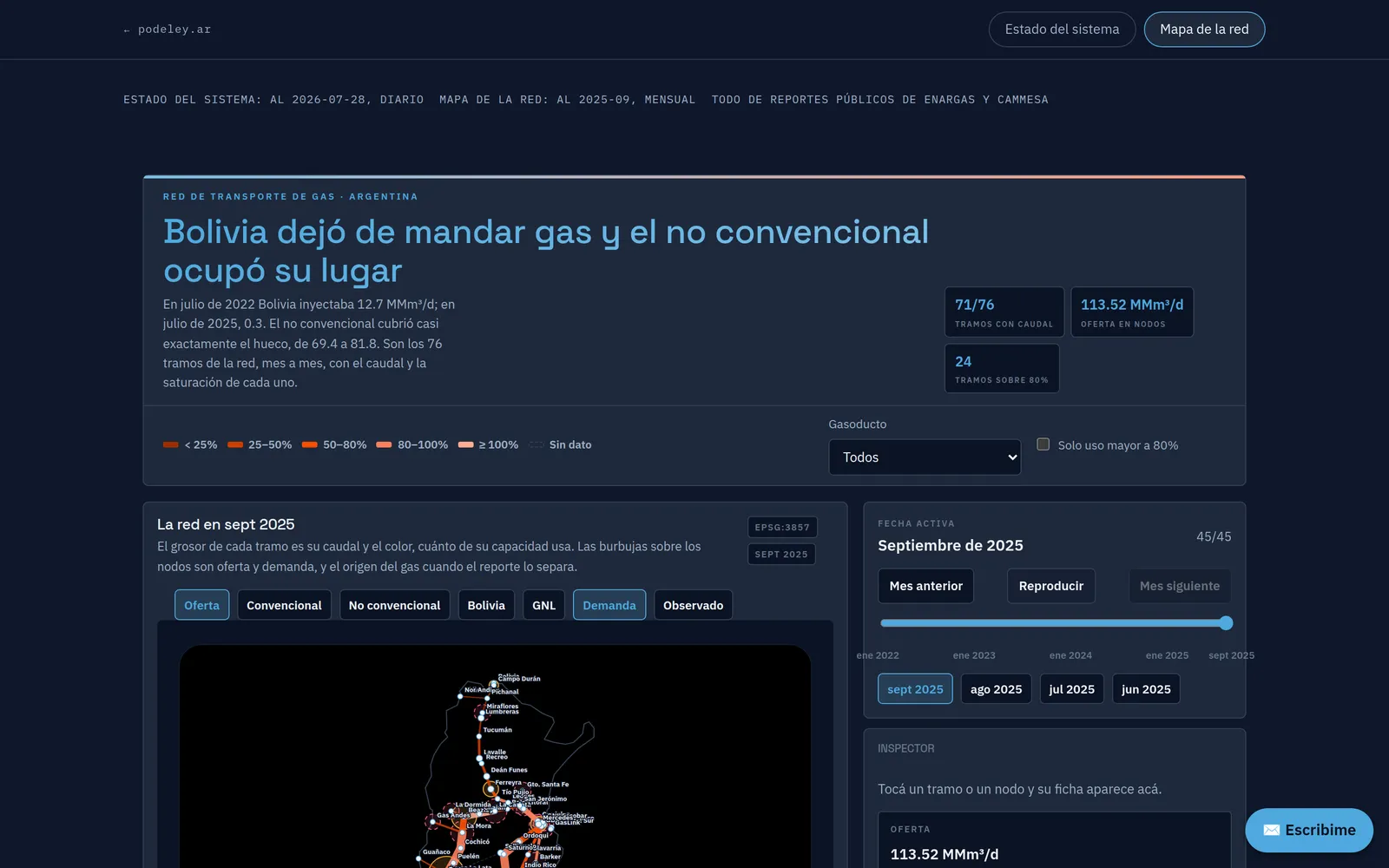 Gas system status and transport network
Demand, linepack and injection for the day, plus 76 transport segments month by month. The fall of Bolivian gas between 2022 and 2025 reads segment by segment, with unconventional filling the gap.
ENARGAS and CAMMESA · system daily · network monthly -
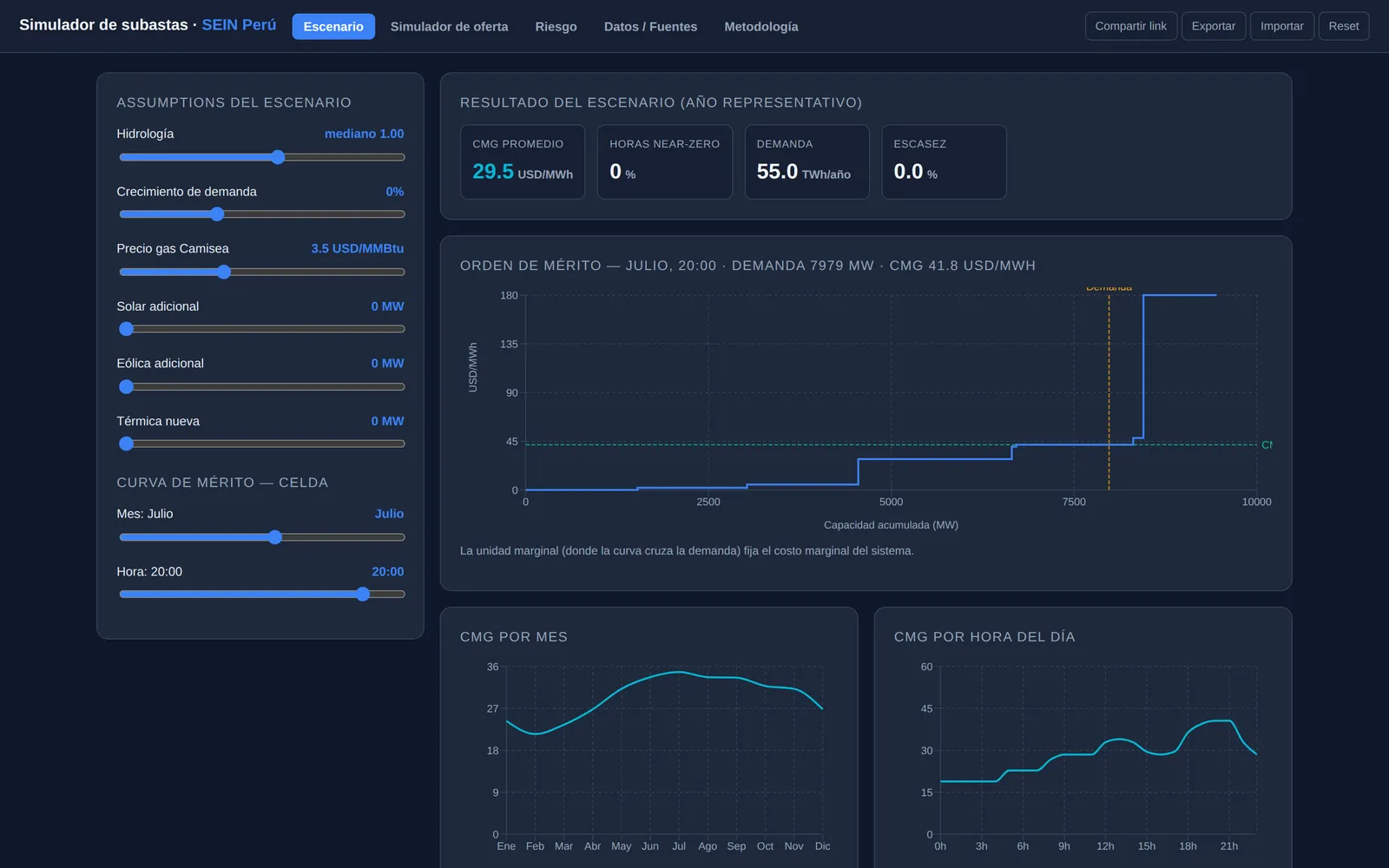 Bid price simulator for power auctions
Merit-order dispatch and Monte Carlo over hydrology, demand, gas price and renewable resource: what to bid, and what overshooting or undershooting costs.
COES + NASA POWER · SEIN, Peru · runs daily
Cybersecurity in energy 3 pieces
What the sector exposes, with no one to report it to. The three pieces and the reasoning: cyber.
-
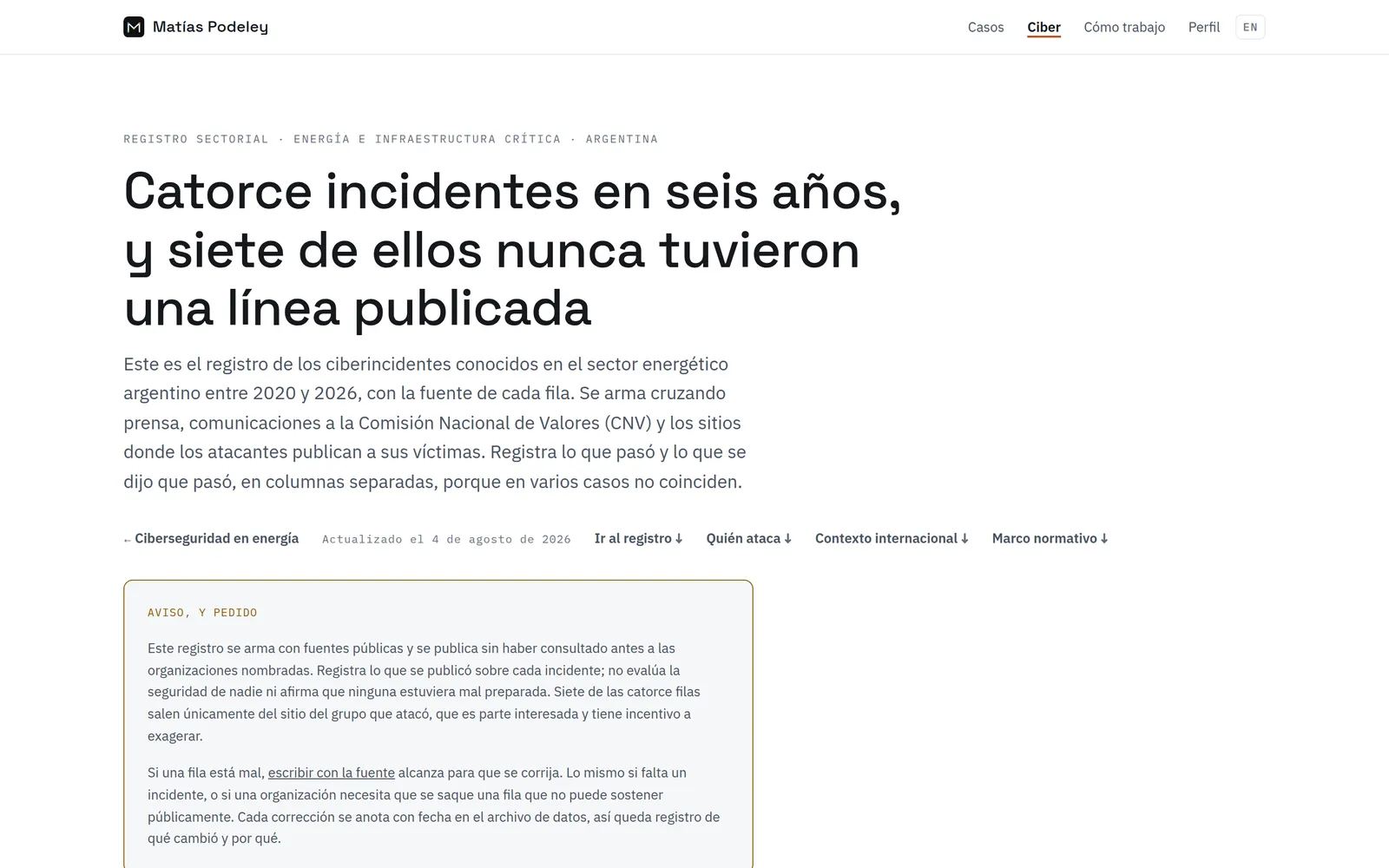 Cyber incident registry
Fourteen cases in Argentine energy and critical infrastructure between 2020 and 2026, with a source on every row and profiles of the eleven attacking groups. Seven surfaced through neither the company nor a regulator.
Open registry · downloadable dataset · CC BY 4.0 -
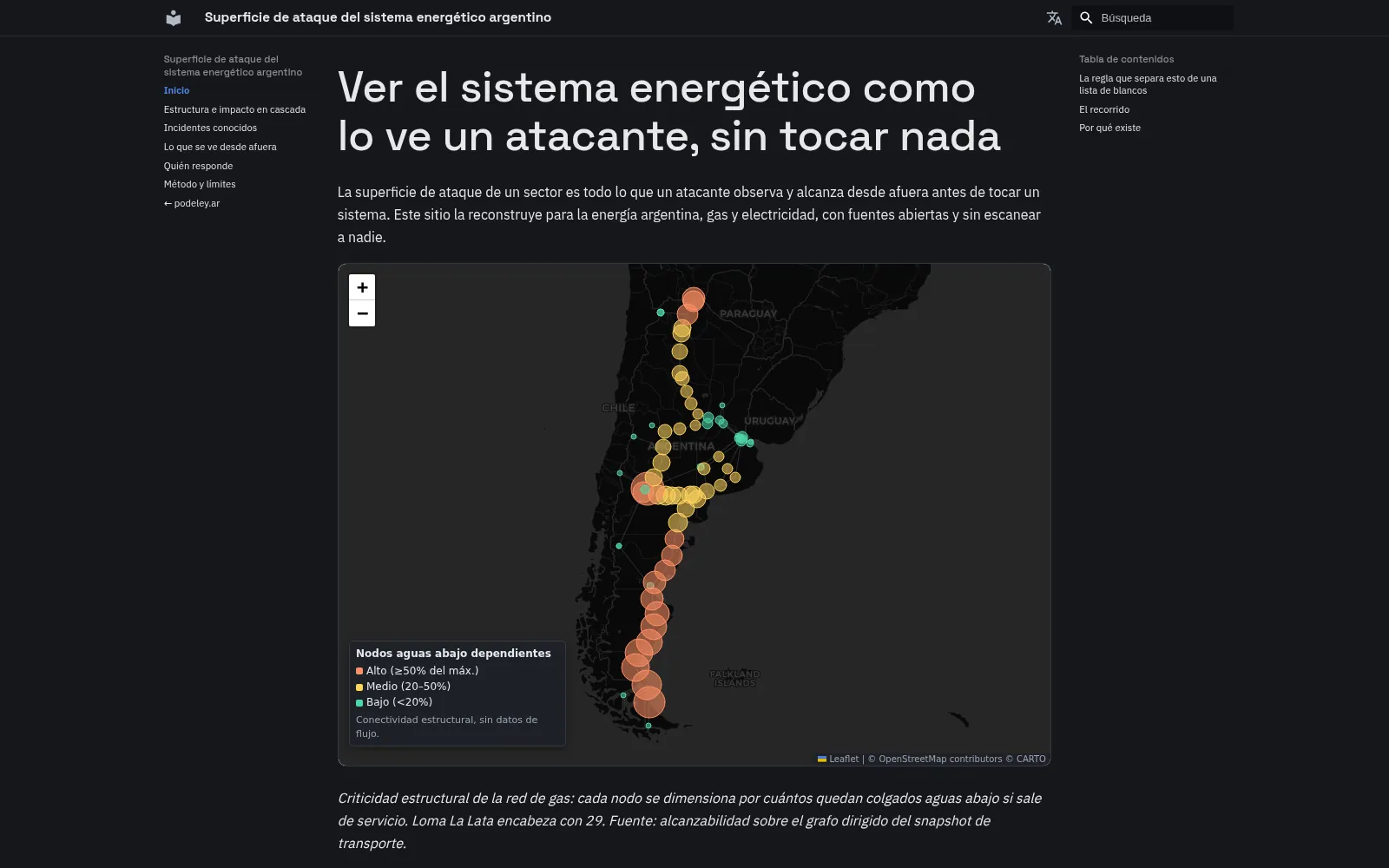 Attack surface map
Six layers built on open sources: network structure, cascading impact, incidents, per-operator network exposure, satellite activity and governance. It publishes the aggregate, never the target.
Open sources · nothing scanned · ES and EN -
 Memo for a sector CERT
What the first year of the US oil & gas ISAC cost, how the Danish SektorCERT works, and three budget scenarios for building the Argentine equivalent.
Costs from tax filings · two draft regulations
Regulation and investment 1 piece
What was committed, read off the resolution.
-
 RIGI registry
Twenty-one projects admitted to Argentina's large-investment incentive regime and USD 29,485 M in qualifying assets, with each one's schedule and deadline, built by reading the Official Gazette resolutions.
Official Gazette · downloadable dataset · CC BY 4.0
Outside the sector
Interpretability research
A paper on how a model assembles an answer, and a note on whether a thousand AI agents sharing a message board have something like a culture. Also the first consolidated course on the subject in Spanish, and an open lab notebook with the bugs left in. Different audience, different register: research.
Contact
The same thing, on your asset
All of them run on public data, which is what makes it possible to leave them online. With an operation's own data inside they answer questions no public version reaches. At what size that happens is covered in how I work.
matias@podeley.ar · Buenos Aires